
 5:47
Cisco certificationCisco exam 200-301 (CCNA v1.1)मराठी + English
CCNA 200-301, explained in Marathi
The CCNA is Cisco's entry-level networking certification and the most common first step into network support, NOC and telecom roles. Prof. Thorat teaches it the way she teaches in the classroom: one concept at a time, in plain Marathi, with the English exam terms kept intact so you can still answer in English.
Most CCNA material assumes you are comfortable with technical English. Many engineering and diploma students in Maharashtra understand a concept faster when it is first explained in Marathi. This hub collects her free CCNA in Marathi playlist, the structured Udemy course and the lessons on this site in a sensible order.
Start with how networks are built (devices, media, topologies), move to the OSI and TCP/IP models, then spend real time on IPv4 addressing and subnetting, because almost every later topic depends on it. Practise each idea in Cisco Packet Tracer as you go: configure hostnames and passwords, assign IP addresses, then prove connectivity with ping.
Syllabus
CCNA 200-301 exam topics (Cisco blueprint v1.1)
1.0 Network Fundamentals (20%)
Network components, topologies, cabling (copper and fiber), TCP vs UDP, IPv4 addressing and subnetting, private addressing, IPv6 addressing, wireless and virtualization basics, switching concepts.
2.0 Network Access (20%)
VLANs, trunking (802.1Q), inter-switch connectivity, CDP/LLDP, EtherChannel, Rapid PVST+, Cisco wireless architectures and WLAN configuration.
3.0 IP Connectivity (25%)
Reading the routing table, how a router makes a forwarding decision, static routing for IPv4/IPv6, single-area OSPFv2, first-hop redundancy.
4.0 IP Services (10%)
Inside source NAT, NTP, DHCP and DNS, SNMP, syslog, QoS concepts, SSH and TFTP/FTP.
5.0 Security Fundamentals (15%)
Threats and mitigation, password policies, access control lists, Layer 2 security (DHCP snooping, port security), VPN and wireless security basics.
6.0 Automation and Programmability (10%)
How automation changes network management, controller-based and software-defined networking, REST APIs, JSON, and configuration management tools.
Weights are from Cisco's published CCNA 200-301 v1.1 exam topics. Always check cisco.com before you book the exam.
Free lessons
Videos for this subject
Tap to play here.
5:47
 17:09
IPv4 Problems: Routing, Default Gateway & IPv6 Basics
Watch on YouTube (opens in new tab) 8:23
IPv4 Header Explained in Marathi for CCNA
Watch on YouTube (opens in new tab) 17:23
Data Link Layer in Marathi: Frames, MAC & Layer 2 Address
Watch on YouTube (opens in new tab) 15:20
Binary to IP Address Conversions in Marathi
Watch on YouTube (opens in new tab) 20:21
Network Cables & Media: UTP, Fiber, Wireless (CCNA Marathi)
Watch on YouTube (opens in new tab)
Physical Layer Explained | Encoding, Signaling & Bandwidth | CCNA Marathi #CCNA #CCNAinMarathi
Watch on YouTube (opens in new tab)
Data Access & Addressing | Same & Different IP Network Addressing | CCNA in Marathi #CCNAinMarathi
Watch on YouTube (opens in new tab)
Data Encapsulation Explained | Segmentation, Sequencing | CCNA in Marathi #CCNA #CCNAinMarathi
Watch on YouTube (opens in new tab)Full playlists
Structured course
Want it all in one path?
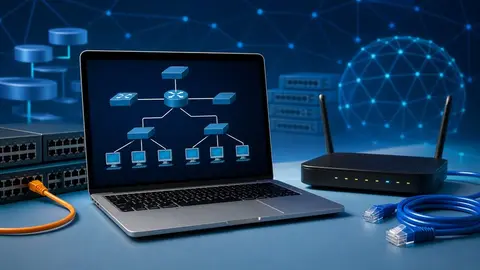
CCNAमराठी
CCNA 200-301 in Marathi: Networking & Packet Tracer
Networking fundamentals, OSI and TCP/IP, IPv4/IPv6 and number conversions, network media, and guided Cisco Packet Tracer labs, all explained in simple Marathi.
- Core networking concepts used in CCNA and entry-level network support roles
- OSI and TCP/IP models with real communication examples
- Install Cisco Packet Tracer and configure device names, passwords, banners and IP addresses
- IPv4, IPv6, binary, decimal and hexadecimal conversions
- Copper, fiber and wireless media; encapsulation and PDUs
4.5 (3 ratings) on Udemy
29 lectures · 5h 45m · updated 10/2026
View on Udemy (opens in new tab)FAQ
Questions students ask
Is the CCNA taught fully in Marathi?
The explanations are in Marathi, while the technical terms (subnet mask, VLAN, OSPF and so on) stay in English, exactly as they appear in the Cisco exam. That way you understand the idea in your own language and can still write or speak about it in English.
Do I need any prior networking knowledge?
No. The CCNA in Marathi playlist and the Udemy course both start from what a network is, which devices are involved and how data moves. Basic computer skills are enough.
Which software do I need for practice?
Cisco Packet Tracer, which is free through Cisco Networking Academy. Prof. Thorat also has GNS3 tutorials (in Marathi and English) for connecting two routers.
How is the free YouTube playlist different from the Udemy course?
The YouTube playlist is free and grows over time. The Udemy course arranges the foundation topics into 29 lectures (about 5 h 45 min) in one structured path, with Packet Tracer lab sessions.
Where should I begin if subnetting scares me?
Read the IPv4 subnetting lesson on this site and download the free revision sheet. It uses just two formulas and one fully solved /26 example.